What Is a BMS (Battery Management System)?
You have probably seen "BMS" printed on an e-bike listing or a phone teardown video and wondered what the letters actually mean. It sounds like a niche engineering term, but a BMS is working inside almost every rechargeable lithium device you own right now, from the phone in your pocket to the solar battery in someone's garage. Understanding what it does explains a lot of everyday battery behavior that otherwise looks mysterious.
Quick answer: A BMS, or battery management system, is the electronic circuit wired between a rechargeable lithium cell and the rest of a device. It enforces safe voltage limits (stopping overcharge and over-discharge), current limits (stopping overcurrent and short circuits), and temperature limits, while also estimating the charge percentage and, in multi-cell packs, balancing individual cells so they age together. It is a protective and reporting layer, not a performance layer: a BMS never makes a device charge faster or add power, it only keeps the battery inside the limits its chemistry requires. Every lithium-ion device, phones, laptops, e-bikes, EVs, and solar storage, relies on one, though the scale and complexity differ enormously between a single-cell phone battery and a pack with hundreds of cells.
What you'll learn
- What a battery management system actually monitors and controls
- How voltage protection stops overcharging and over-discharging
- How current, short-circuit, and temperature protection work together
- How a BMS estimates charge percentage and balances multi-cell packs
- Where BMS units show up, from phones to e-rickshaws to EVs to solar storage
What a BMS actually does
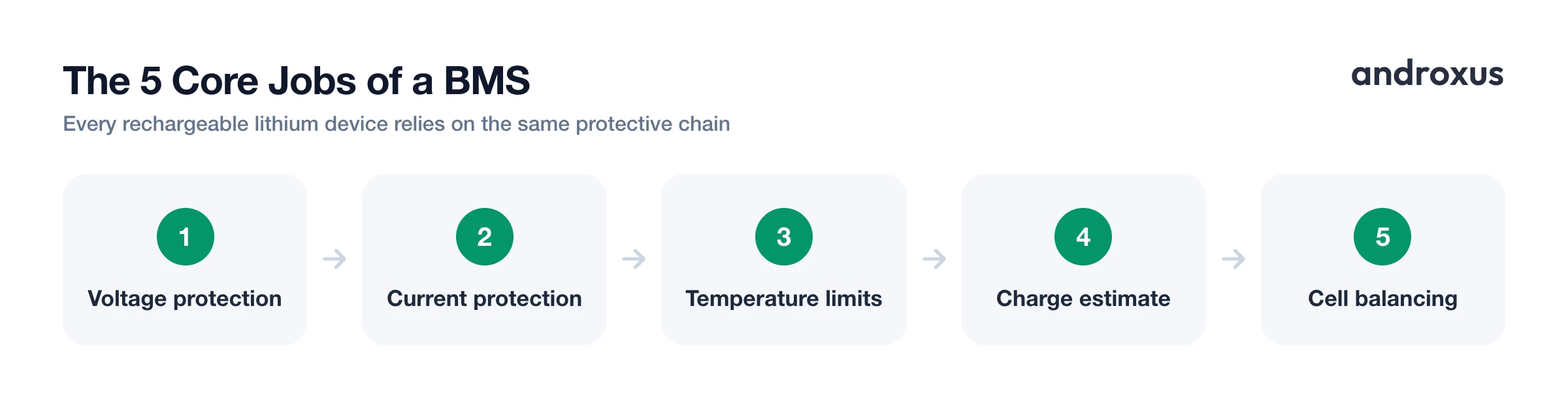
A battery management system is the electronic circuit or chip wired between a rechargeable lithium cell, or a pack of cells, and the rest of the device it powers. It has five core jobs: voltage protection (cutting off overvoltage and undervoltage), current protection (cutting off overcurrent and short circuits), temperature monitoring and cutoff, state of charge estimation, and cell balancing in any pack built from more than one cell in series.
You will find a BMS in anything built around a rechargeable lithium-ion or lithium-polymer cell: phones, laptops, e-bikes, e-rickshaws, electric vehicles, and home solar storage batteries. Without a working BMS, a lithium cell has no built-in safety margin. Charging past its rated top voltage, discharging past its rated bottom voltage, or pulling more current than it is rated for can each cause permanent capacity loss, and in the worst case, thermal runaway.
It is worth being clear about what a BMS is not. It is a protective and reporting layer, not a performance layer. It does not add power, it does not speed up charging, and it does not improve efficiency. It enforces the limits the cell chemistry requires and reports status back to the host device. Every fast-charging watt figure you see on a phone comes from the charging controller negotiating a protocol with the charger, not from anything the BMS adds.
Voltage protection: overvoltage and undervoltage cutoff
Standard lithium-ion cells run at 3.6V to 3.7V nominal and are considered fully charged at 4.2V per cell. Some flagship phones and wireless earbuds use high-voltage (LiHv) cells for extra energy density, charging to 4.35V, 4.4V, or 4.45V per cell with a nominal voltage around 3.8V to 3.95V.
Overvoltage protection stops charge current the instant a cell reaches its rated maximum, whether that is the standard 4.2V or the higher 4.35V to 4.45V ceiling used by LiHv cells. This matters because pushing past that ceiling breaks down the electrolyte and plates lithium metal onto the anode, both of which permanently reduce usable capacity.
Undervoltage protection works at the other end. A cell discharged below roughly 2.5V risks permanent damage from copper dissolving off the anode's current collector. That is why your phone's software typically reports 0 percent well before the cell is actually empty, usually around 3.0V to 3.3V per cell, as a safety buffer. A separate hardware protection circuit then disconnects the cell entirely near 2.4V to 2.5V, before real damage can occur. In other words, the "empty" point you see on screen is a protective cutoff enforced by the BMS, not the cell's true physical minimum.
Current, short circuit, and temperature protection
Overcurrent protection caps the charge and discharge current to whatever the cell or pack is rated for. A sustained overload gets cut off within milliseconds. Short-circuit protection is much faster still, typically tripping in under 200 microseconds up to a few milliseconds, because a direct short can generate damaging heat almost instantly.
Temperature limits matter just as much as voltage and current. The widely used JEITA guideline treats 0C to 45C (32F to 113F) as the safe charging range. Many BMS units reduce charge voltage and current above 45C and stop charging entirely above 60C (140F). Discharge tolerates a wider range, roughly -20C to 60C (-4F to 140F). These are exactly the limits a BMS is enforcing when a phone refuses to charge, or charges noticeably slower, after being left in a hot car or a freezing environment. That "charging paused, battery too warm" message you occasionally see is the BMS doing its job, not a malfunction.
State of charge estimation and cell balancing
The percentage on a battery icon is an estimate, not a direct measurement of remaining charge. The BMS calculates it mainly through coulomb counting, integrating the current flowing in and out of the cell over time. Coulomb counting alone accumulates drift over long periods, so the BMS periodically cross-checks against the cell's open-circuit voltage using a pre-stored voltage-to-charge lookup table, resetting the estimate back to an accurate figure.
Multi-cell packs, found in laptops, e-bikes, e-rickshaws, EVs, and solar storage, wire several cells in series to reach a higher voltage. Manufacturing variance and uneven aging cause individual cells to drift apart in charge level over time, which is where cell balancing comes in. Passive balancing bleeds excess charge off the fuller cells through small resistors until every cell in the series string matches, simple and cheap, but the excess energy is wasted as heat. Active balancing instead shuttles charge from fuller cells to weaker ones using inductive or capacitive circuits, wasting less energy at the cost of added complexity and price. Active balancing shows up more often in higher-end packs such as EVs, where keeping hundreds of cells matched extends the whole pack's usable life.
Where BMS units show up: phones to e-rickshaws to EVs
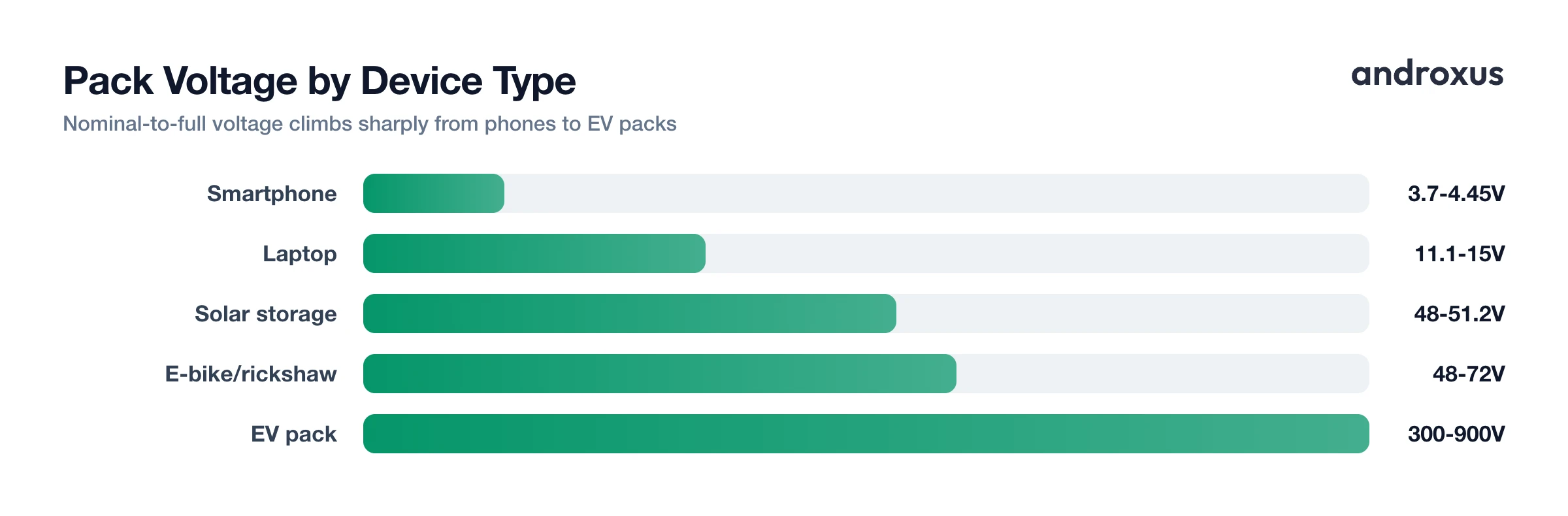
The same five protective functions scale from a single phone cell up to a pack of hundreds of cells, but the voltage class, arrangement, and complexity change dramatically depending on the device.
| Device type | Typical pack voltage | Cell arrangement | Primary BMS focus | Readable by a phone monitoring app |
|---|---|---|---|---|
| Smartphone | 3.7-3.85V nominal (4.2-4.45V full) | 1 cell, rarely 2 | Voltage/temperature cutoff, SoC estimate | Yes, it is the phone's own battery |
| Laptop | 11.1-15V nominal | 3-4 cells in series, often with parallel groups (e.g., 3S2P) | Balancing across series cells, thermal limits | No, a separate device with its own BMS |
| E-bike / e-rickshaw | 48V, 60V, or 72V nominal | Many cells in series and parallel strings | High-current discharge limits, cell balancing | No, separate BMS hardware |
| Electric vehicle | 300-500V (400V class) or 700-900V (800V class) | Hundreds of cells across series/parallel modules | Pack-wide balancing, thermal management, CAN bus reporting | No, separate BMS hardware |
| Home solar storage | 48V or 51.2V nominal (LiFePO4) | Multiple cells in series per rack/module | Overvoltage/undervoltage/overcurrent protection, balancing | No, separate BMS hardware |
A few numbers worth holding onto: laptop packs commonly run three cells in series for about 11.1V nominal, sometimes wired 3S2P (three in series, two in parallel) to add capacity without raising voltage. E-bikes and e-rickshaws increasingly replace strings of four to six 12V lead-acid batteries with a single lithium pack at 48V, 60V, or 72V, and lithium packs typically last 1,000 to 3,000 charge cycles versus roughly 200 to 400 cycles for flooded lead-acid. On the EV side, pack voltage generally falls into two classes: 300V to 500V (Tesla Model 3 runs around 350V, Model Y around 400V) and 700V to 900V (Tesla Cybertruck uses 800V-class architecture). The 800V class typically supports peak charging rates from roughly 240kW to 350kW depending on the vehicle, enabling a 10 to 80 percent charge in around 18 to 20 minutes for many models, versus roughly 150kW to 200kW typical for 400V systems. Home solar storage racks commonly run LiFePO4 chemistry at 48V or 51.2V nominal in modules around 100Ah/5kWh or 200Ah/10kWh, comparable in scale to Tesla Powerwall-class systems.
Phone BMS vs. large vehicle pack BMS: what's different
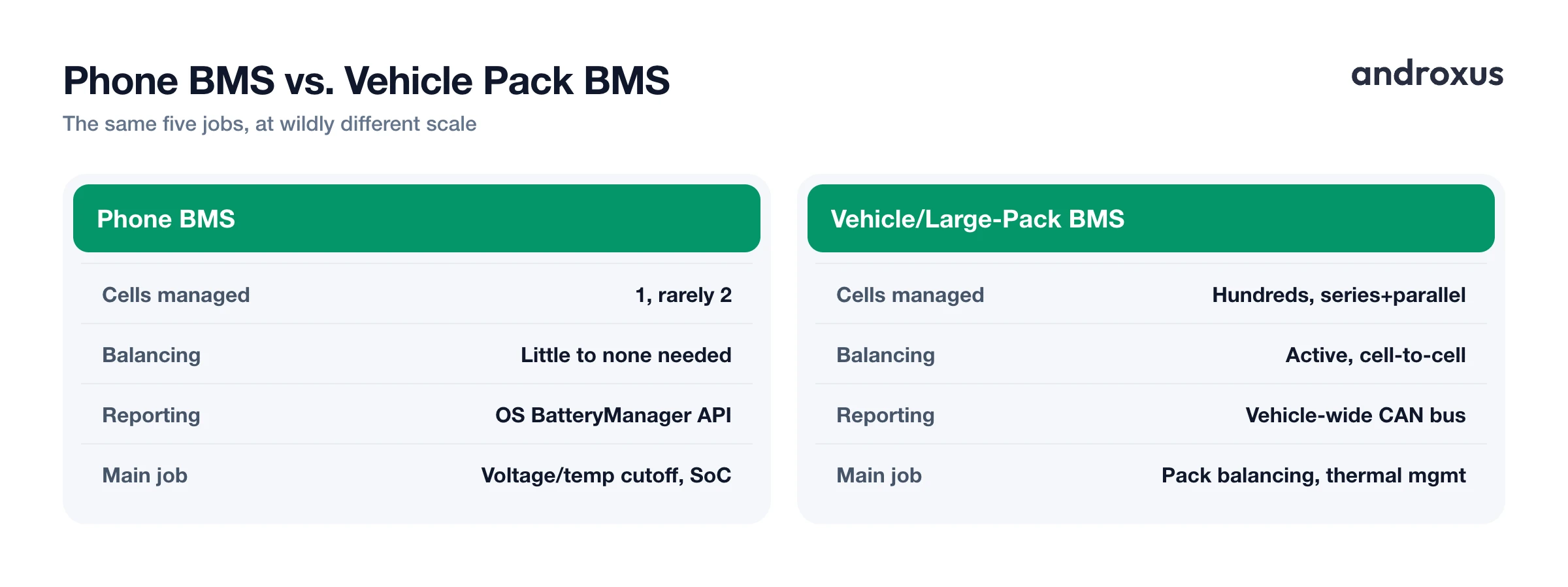
A phone BMS manages one or, rarely, two cells. There is no real cell-to-cell balancing to do, so its main job is voltage and temperature cutoff plus charge estimation, reported straight to the operating system. Android exposes this data through the BatteryManager API: EXTRA_TEMPERATURE in tenths of a degree Celsius, EXTRA_VOLTAGE in millivolts, and BATTERY_PLUGGED_AC/USB/WIRELESS constants that identify which charging source is connected.
A vehicle or large-pack BMS is a different scale of problem entirely. It manages hundreds of cells wired in series and parallel, must actively balance every cell relative to its neighbors, coordinates a dedicated thermal management and cooling loop, and reports over a vehicle-wide CAN bus rather than a simple OS-level API. You can see your own phone's BMS-reported numbers, voltage, temperature, current, and health estimate, in real time with an app like AmpereFlow, which reads the same Android battery APIs and corrects manufacturer-specific current and voltage reporting quirks across thousands of device models.
It is worth being precise about the boundary here. AmpereFlow reads only your phone's own internal battery data. It does not connect to, pair with, or control external BMS hardware in an e-rickshaw, EV, scooter, solar system, or lead-acid battery pack. Those systems run entirely separate BMS hardware of their own, with no phone-app access, and no consumer app can legitimately claim otherwise.
How to check what your phone's BMS is reporting
- Check the reported charge percentage. Open Settings > Battery on your phone to see the charge level your device's built-in BMS and fuel-gauge chip is currently reporting.
- Watch the charging status. Plug in your charger and note whether the phone reports fast charging, standard charging, or shows a wattage figure. This reflects the current level the BMS is allowing through for that specific charger and cable.
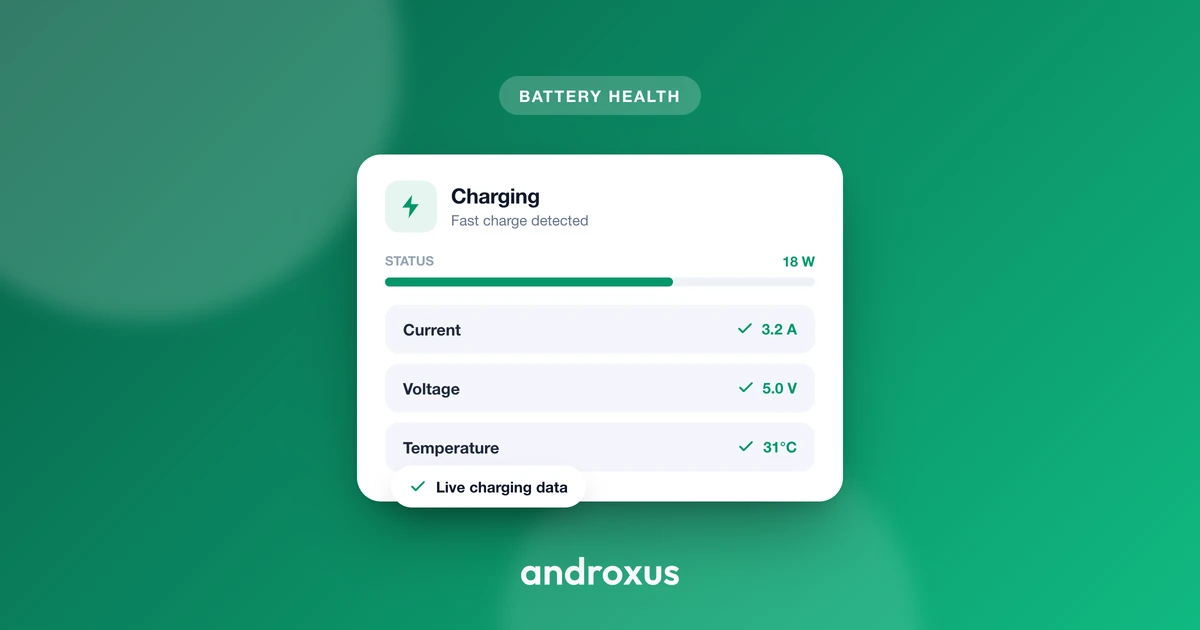
- View live voltage, current, and temperature. Install a battery monitoring app to see the live voltage, current in watts and amps, and battery temperature that Android's BatteryManager API exposes from the phone's own BMS.
- Check battery health periodically. Review the battery health or capacity estimate every few months to see how today's usable capacity compares with the original rated mAh, a sign of the long-term cell wear the BMS has been managing.
- Avoid extreme conditions during charging. Do not leave a phone charging in temperatures outside roughly 0 to 45C (32 to 113F), and avoid letting it sit at 0 percent for long periods. These are exactly the conditions the BMS's protective cutoffs exist to guard against.
- Review charge history for anomalies. If your monitoring app logs charge sessions, check past sessions to spot unusual drops in charging speed, which often point to a worn cable, charger, or port rather than a battery problem.
Key takeaways
- A BMS is the electronic circuit that protects a lithium battery by enforcing voltage, current, and temperature limits, estimating charge level, and balancing cells in multi-cell packs.
- Overvoltage protection stops charging at 4.2V (or 4.35V to 4.45V for LiHv cells) per cell, while undervoltage protection cuts off near 2.4V to 2.5V, well below the 0 percent your phone displays.
- Short-circuit protection reacts in under a few milliseconds, and temperature limits (roughly 0C to 45C for charging) explain why a phone slows or pauses charging when it gets too hot or cold.
- BMS complexity scales with the pack: a phone manages one cell with simple cutoffs, while an EV or e-rickshaw pack actively balances hundreds of cells and adds a dedicated thermal management system.
- A battery monitoring app can show you your own phone's BMS-reported voltage, temperature, current, and health, but it has no access to external BMS hardware in vehicles, e-bikes, or solar storage.
Frequently asked questions
What does BMS stand for?
BMS stands for Battery Management System, the electronic circuitry that monitors and protects a rechargeable lithium battery by controlling voltage limits, current limits, temperature limits, estimating charge level, and balancing cells in packs with more than one cell wired in series.
Does my Android phone have a BMS?
Yes. Every phone with a lithium-ion or lithium-polymer battery has a small BMS, often called a fuel-gauge chip, built into the battery or charging circuit. It enforces voltage cutoffs around 4.2V to 4.45V when full and roughly 2.5V to 3.3V when empty, limits charge and discharge current, watches temperature, and estimates the percentage shown on screen.
What is the difference between a phone BMS and an EV or e-rickshaw BMS?
A phone BMS manages one or two cells with little need for balancing. An EV or e-rickshaw BMS manages hundreds of cells wired in series and parallel, actively balancing charge across every cell and coordinating a thermal management system, tasks a single-cell phone battery never needs. EVs typically run 300-500V or 700-900V packs, while e-rickshaws commonly run 48V, 60V, or 72V packs.
What happens if a BMS fails or is bypassed?
Without functioning voltage, current, and temperature protection, a lithium cell can be overcharged past its rated voltage, discharged too far, or pushed past its safe current limit. Any of these can cause permanent capacity loss, physical swelling, or in the worst case thermal runaway. This is why BMS protection is a mandatory part of lithium battery design, not an optional feature.
Can an app on my phone read BMS data directly?
An app can read what Android's BatteryManager API exposes, including voltage, temperature, charge level, current, and plugged-in status, which comes from the phone's own internal BMS. It cannot see or control BMS hardware in a separate device such as an e-bike, EV, or solar battery pack, since those run entirely independent BMS hardware with no phone-app access.
Does a BMS make a battery charge faster?
No. A BMS's role is protective and estimative: it enforces safe voltage, current, and temperature limits and reports charge state, it does not increase charging speed. Charging speed is set by the charger, cable, and the device's own charging controller negotiating a power delivery protocol, the BMS only makes sure the power actually delivered stays within safe limits for the cells.
