Is It Legal to Record? Consent Laws Explained
You are walking to your car after a late shift, a delivery goes wrong, or a conversation turns tense, and your first instinct is to hit record. That instinct is reasonable, but the law around it is not the same everywhere. Before a recording can help you, it helps to know whether it's legal, and how to make it hold up.
Quick answer: Whether it's legal to record depends on where you are and who else is in the conversation. Federal law only requires one-party consent, meaning you can record a conversation you're part of, but roughly a dozen states require all-party consent instead. Public settings with no expectation of privacy, like a sidewalk or a police stop, are generally fine to record; private settings like a home, closed office, or a bathroom are not, regardless of your state's consent rule.
What you'll learn
- The difference between one-party and all-party consent states, and which is more common
- How courts decide whether a place or conversation counts as private
- Where recording police fits into the law
- How Android signals to everyone nearby that recording is happening
- Simple habits that make a recording more credible if you ever need to use it
- Step-by-step guidance for recording a conversation or incident responsibly
Is It Legal to Record? The Short Answer
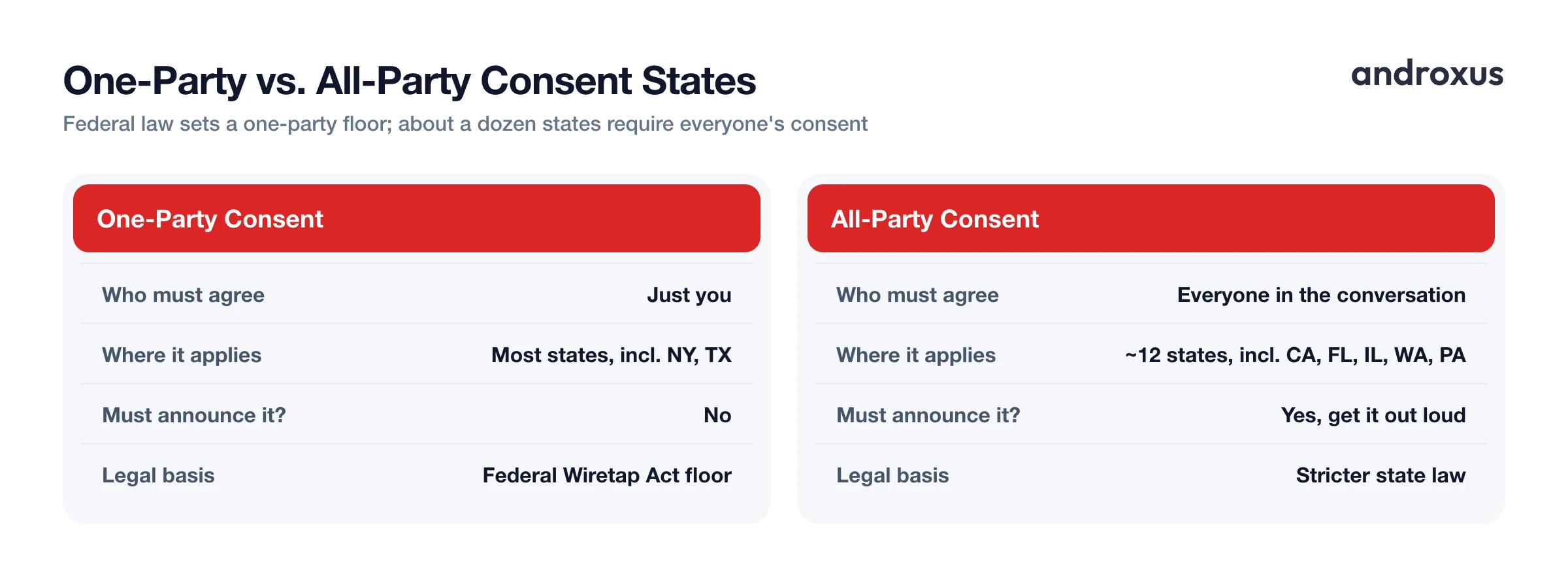
The Federal Wiretap Act (18 U.S.C. 2511) sets a floor, not a ceiling. Under federal law, if you're a participant in a call or conversation, you can record it without telling the other person, as long as you're not doing it to commit a crime or a civil wrong. That's called one-party consent, and it's the default rule in most of the country, including states like New York and Texas.
States are free to require more than federal law does, and roughly a dozen of them do. States commonly cited as requiring all-party consent include California, Connecticut, Florida, Illinois, Maryland, Massachusetts, Montana, Nevada, New Hampshire, Oregon, Pennsylvania, and Washington. Exact lists shift slightly depending on the source, and a few states have hybrid rules, so treat this as a starting point rather than a final answer, and check your specific state before you rely on it.
You'll often see this called "two-party consent," but that phrase is a bit misleading. The real rule is all-party consent: every person taking part in a private conversation has to agree before it's recorded, not just two people out of a larger group.
This article is general information, not legal advice. When a recording actually matters, a legal dispute, a workplace complaint, a safety incident, confirm the current rule in the specific state or states involved before you act on it.
One-Party vs. All-Party Consent States
In a one-party consent state, only one person in the conversation needs to agree to the recording, and that person can be you. You don't have to announce it or ask permission.
In an all-party consent state, everyone taking part in a private conversation must agree before it's recorded. Recording without that consent can be a criminal offense in some of these states, not just grounds for a civil claim.
The rule that applies is usually tied to where the conversation happens or where the parties are located, which gets complicated fast for a phone call between two different states. When you're not sure which rule applies, follow the stricter one.
Illinois is a good example of how these laws evolve. Its older eavesdropping statute was struck down by courts as unconstitutional, and the state rewrote it in 2014. The current Illinois law only requires all-party consent where there's a reasonable expectation of privacy, not for recording in public.
Public vs. Private: The Reasonable Expectation of Privacy Test
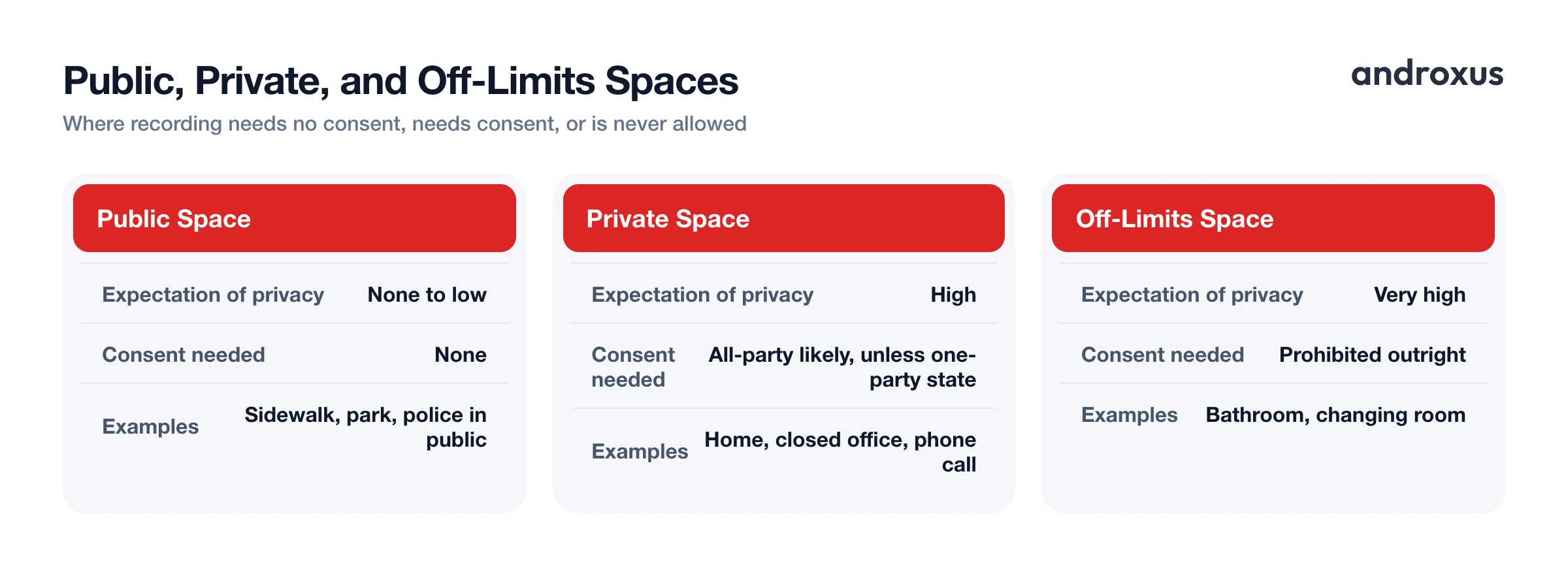
Even in all-party consent states, the consent requirement generally applies only where people have a reasonable expectation of privacy, not in public places where a conversation could be overheard by anyone.
Courts weigh two things: whether the people involved believed the conversation was private, and whether that belief was reasonable given the setting. A conversation on a public sidewalk is treated very differently from one behind a closed office door, even if the words spoken are similar.
Recording police officers performing their duties in public is one of the clearer areas of the law. A majority of federal circuit courts have recognized a First Amendment right to record police in public, including audio, not just video. The limits are practical, not legal: you can't interfere with the officer's work, and you should record openly rather than covertly, since some states still treat secret audio recording differently from visible video recording.
Some places are off-limits to record no matter what your state's consent law says. Bathrooms, changing rooms, and similarly private spaces are covered by separate voyeurism and invasion-of-privacy statutes in every state, and those laws apply regardless of consent rules or intent.
Setting and Consent at a Glance
| Setting or scenario | Reasonable expectation of privacy? | Typical consent needed | Notes |
|---|---|---|---|
| Public sidewalk or park | No | None needed | Still can't be used to harass or stalk someone |
| Store or restaurant | Low | Usually none for ambient recording | Some venues post policies, but that's not the same as a legal requirement |
| Private home or closed office | High | All-party consent likely required outside one-party states | Even one-party states may treat it differently if you're recording others' conversation, not your own |
| Phone call you're part of | Varies by state | One-party in most states, all-party in about a dozen | Check the law for every state involved, not just your own |
| Police performing duties in public | Low, for their public conduct | None required, per First Amendment case law | Can't interfere with the officer's work |
| Bathroom, changing room, or similarly private space | Very high | Recording is prohibited outright | Voyeurism laws apply regardless of consent-law type |
How Android Signals That Recording Is Happening
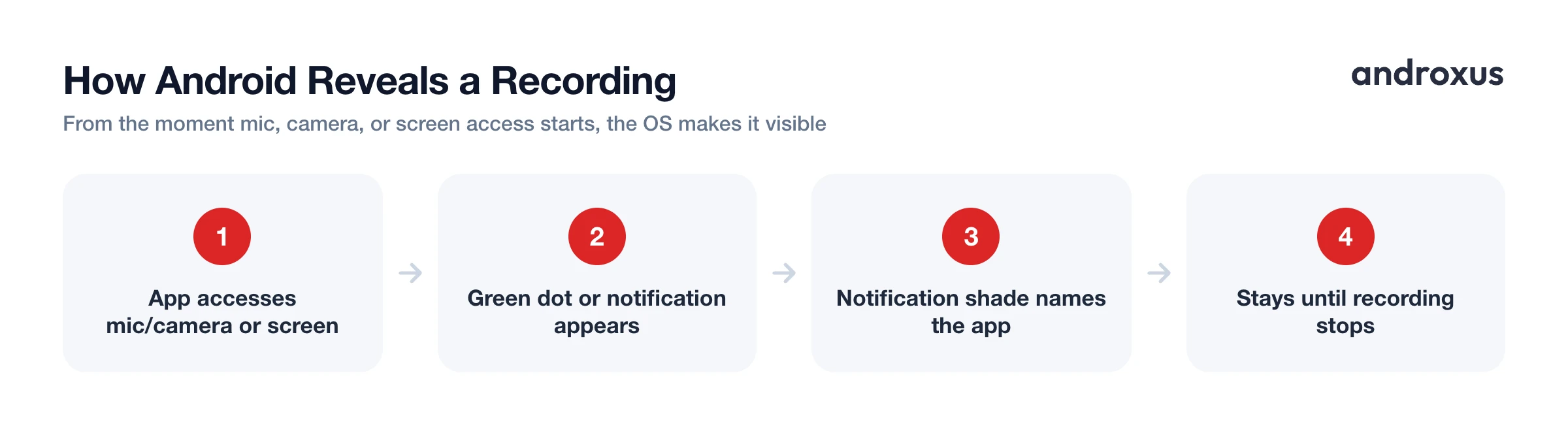
One reason recording deserves care is that modern phones make it hard to record invisibly, and that's by design. Since Android 12, a green dot appears in the status bar the moment any app uses the camera or microphone, and swiping down the notification shade shows exactly which app it is. The indicator can linger for a few seconds after access ends, since Android treats mic and camera use as active for a short grace period after the last access.
Screen recording works through a separate system called MediaProjection, and it's just as visible. On Android 10 and later, an app cannot legally run screen capture without first showing a persistent, non-dismissible notification for as long as recording is active. That notification is enforced by the operating system itself, not by any individual app, so it can't be turned off or hidden by app-level settings.
This matters for how you should think about recording tools generally. A legitimate app built for personal safety, whether it's capturing your screen, recording video in the background, or saving audio, will still show these system indicators, because it has no way to suppress them. SafeCam, for example, is built around instant SOS triggers and screen-off background recording, and it respects those same device indicators rather than working around them.
Recording Evidence Responsibly: Practical Habits
A recording is only as useful as it is credible, and a few small habits make a real difference.
Say the date, time, and reason for recording out loud near the beginning of the clip. This creates a simple, built-in record of context and, where relevant, of consent.
Leave the original file untouched. If you ever need to share or trim a clip, make that edit on a duplicate and keep the raw, unedited file with its original timestamp and filename intact. An unedited, time-stamped recording holds up far better than a polished one that's been cut down, because editing raises questions about what was left out.
Tools built specifically for personal safety take some of this off your plate automatically. SafeCam's background and screen recorders save files with time-stamped filenames and keep them local to the device, which helps preserve an unedited record without you having to think about it in the moment.
Keep the purpose in mind, too. Recording is a tool for documenting your own situation, a commute, a delivery, an uncomfortable encounter, not for tracking or monitoring another person. Using any recording tool to harass, stalk, or covertly surveil someone else is not just unethical; in most places it's also illegal, regardless of whether your state uses one-party or all-party consent.
How to Record a Conversation or Incident the Right Way
- Check your state's consent law first. Find out whether your state requires only your own consent or everyone's consent before you record a conversation. This one lookup shapes almost every other decision you'll make.
- Judge whether the setting is public or private. A public sidewalk, store, or meeting generally carries little expectation of privacy. A closed office, home, or hushed one-on-one conversation usually does, even in a one-party consent state.
- Get consent out loud when it's required. If your state requires all-party consent, or you're unsure, simply ask: is it okay if I record this? Let the answer be part of the recording itself.
- Record in a way that preserves a clear, unedited timestamp. Choose a method that saves the original file with its creation date and time and doesn't let you quietly alter it afterward.
- Keep the original file safe and don't edit it. Store the raw recording securely, ideally locally on the device, and only cut or re-export a duplicate if you need to share a shorter clip.
- Never record where it isn't just illegal, it's harmful. Skip bathrooms, changing rooms, and other clearly private spaces, and never use recording to harass, stalk, or monitor someone without a legitimate safety reason.
Key takeaways
- Federal law sets a one-party consent floor, but roughly a dozen states require all-party consent, so check your specific state before recording a private conversation.
- Public settings, including police performing their duties in public, generally carry little expectation of privacy and can be recorded openly.
- Bathrooms, changing rooms, and similar private spaces can never legally be recorded, no matter what your state's consent rule is.
- Android shows a visible indicator any time the camera, microphone, or screen is being recorded, and no legitimate app can hide it.
- A time-stamped, unedited original file, paired with a clear statement of date, time, and purpose, is what makes a recording credible if you ever need it.
Frequently asked questions
Is it legal to record a conversation without telling the other person?
It depends on the state. Federal law (18 U.S.C. 2511) sets a one-party consent floor, meaning you can record a conversation you're part of without telling anyone else, as long as it's not done to commit a crime. About a dozen states, including California, Florida, Illinois, Washington, and Pennsylvania, require all-party consent instead, so check your state's rule before recording someone else's conversation.
Can I record police officers in public?
Generally yes. A majority of federal circuit courts recognize a First Amendment right to record police performing their duties in public, including audio. The caveat: you can't interfere with the officer's work, and some states still treat secret audio recording differently from open video recording, so record visibly and keep your distance.
Does Android tell you when an app is recording?
Yes. Since Android 12, a green dot appears in the status bar whenever an app is using the camera or microphone, and tapping the notification shade shows which app it is. Screen recording works differently but is just as visible: Android requires a persistent, non-dismissible notification the whole time a screen recording is active, and apps cannot legally hide it.
Is it ever legal to record someone in a bathroom or changing room?
No. Recording in places where people have a clear expectation of privacy, like restrooms, changing rooms, or private bedrooms, is prohibited by voyeurism and invasion-of-privacy laws in every state, regardless of whether your state uses one-party or all-party consent for conversations, and regardless of intent.
What makes a recording more credible as evidence?
State the date, time, and purpose out loud near the start of the recording, avoid editing or trimming the file afterward, and keep the original with its original timestamp and filename intact. A clear, unedited, time-stamped file is far more useful later than a polished but altered clip.
Can a personal-safety app be used to secretly record someone without them knowing?
That would misuse the category. Apps like SafeCam are built for personal safety, documenting your own commute, a delivery, or an unsafe encounter, not for surveilling other people. They still respect the device's recording indicators and required notifications; they don't hide the fact that recording is happening from the operating system's perspective.
