Blue Light Eye Strain: What Science Actually Says
Your eyes ache after a long day of screens, and the internet's go-to explanation is blue light. It's a tidy story, but the research tells a more specific one: light color is barely the issue during the day, and its role at night is real but often overstated. Here's what the evidence actually supports, and what to do about it.
Quick answer: Blue light eye strain is not well supported by research. The American Academy of Ophthalmology says there is no evidence digital screens cause permanent eye damage, and a 2023 Cochrane review found blue-light-blocking glasses did not reduce eye strain symptoms. Most digital eye strain comes from a drop in blink rate, uncorrected vision, and poor screen positioning. Blue light's more credible effect is on sleep, where it suppresses melatonin more than other colors in lab studies, though the real-world benefit of blocking it is still modest and debated.
What you'll learn
- Why digital eye strain happens and why it is not permanent eye damage
- The actual causes of eye strain, and how blink rate plays the biggest role
- Where blue light does and does not have credible scientific support
- What the evidence says works, including the 20-20-20 rule
- A practical, step-by-step routine for reducing eye strain day and night
What digital eye strain actually is (and isn't)
Digital eye strain, also called computer vision syndrome, is a cluster of symptoms: eye fatigue, dryness, blurred vision, headaches, and neck or shoulder discomfort tied to prolonged screen use. It's uncomfortable and can affect how well you concentrate or sleep, but it is not a diagnosis of permanent harm.
The American Academy of Ophthalmology (AAO) is direct about this: digital eye strain does not cause permanent eye damage, though it can meaningfully affect comfort and daily quality of life, and it can worsen existing dry eye disease in people who already have it. Symptom severity tends to track with total screen time and habits, like blinking and posture, rather than with the specific device, app, or amount of blue light involved.
Perhaps the most surprising point: the AAO states there is no scientific evidence that the kind or amount of light coming from computer or phone screens is damaging to the eyes. That single line undercuts a lot of the blue-light marketing built around screen use.
The real culprits behind eye strain
If it isn't blue light, what is it? Mostly behavior.
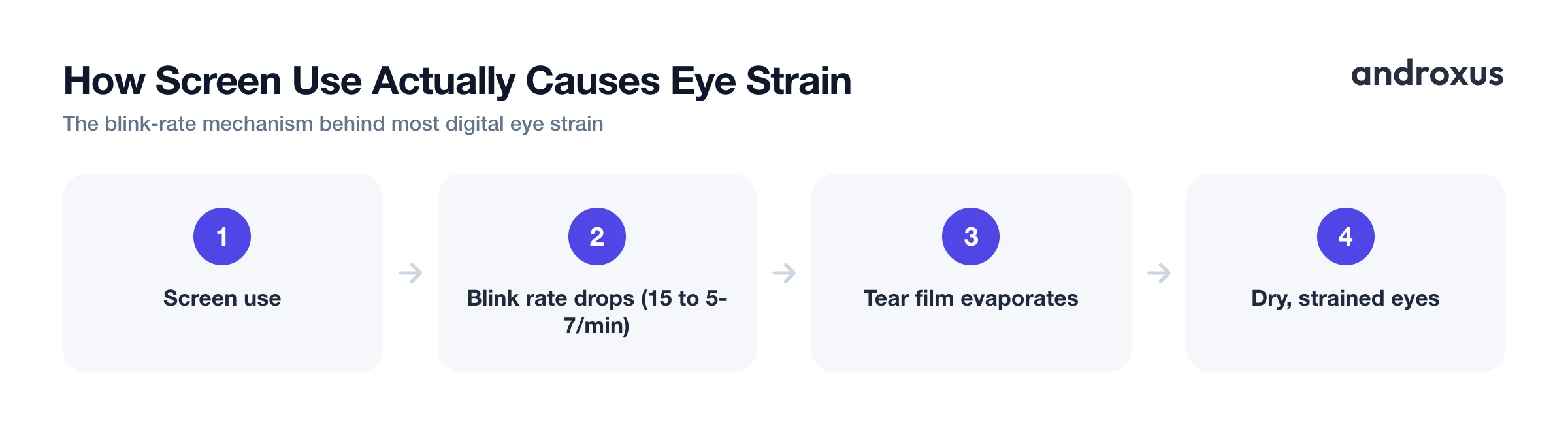
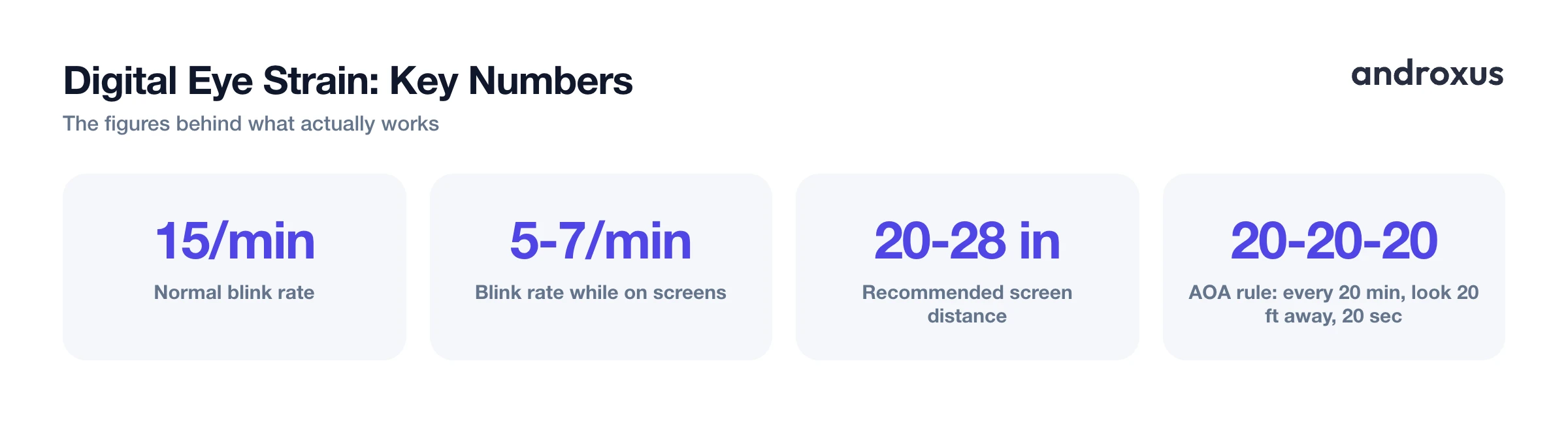
A normal blink rate is about 15 times per minute. While looking at digital screens, people blink as few as 5 to 7 times per minute, roughly a third to half of normal. Fewer blinks means the tear film evaporates faster, drying out the eye's surface. This is one of the best-documented mechanisms behind digital eye strain, and it alone explains most of the classic "screen fatigue" feeling.
Several other factors compound this:
- More than 4 hours of daily device use
- Pre-existing dry eye
- Uncorrected refractive error (nearsightedness, farsightedness, astigmatism, presbyopia)
- Low-humidity rooms or airflow from fans or AC vents blowing across the face
- Poor screen positioning, including screens that are too close, too high, or catching glare from windows or overhead lights
The American Optometric Association (AOA) recommends positioning screens 20 to 28 inches from the eyes, with the center of the screen about 4 to 5 inches below eye level, specifically to reduce this kind of strain.
Where blue light actually fits in
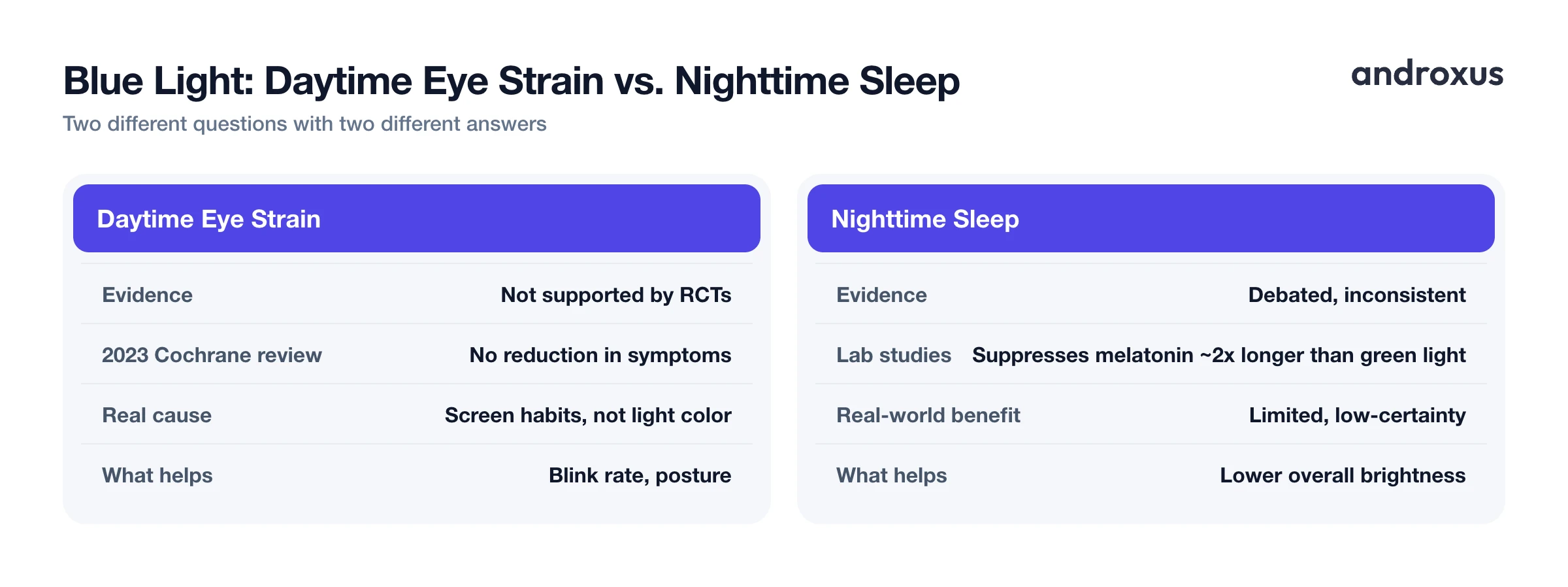
Blue light isn't irrelevant, it's just misapplied in most conversations about eye strain. Two separate questions get conflated: does blue light strain your eyes during the day, and does blue light affect your sleep at night. The evidence answers them very differently.
For daytime eye strain, the case is weak. A 2023 Cochrane systematic review of randomized controlled trials found blue-light-filtering lenses did not reduce eye strain symptoms compared with regular lenses during short-term computer use. The AAO does not recommend special computer eyewear for eye strain, and attributes discomfort mainly to screen habits, not to blue light exposure itself.
For sleep and circadian rhythm, the case is more legitimate, though still not settled. Harvard sleep researchers found blue light suppressed melatonin roughly twice as long, and shifted circadian rhythm about twice as much, as green light of comparable brightness. Even fairly dim light, around 8 lux, dimmer than most table lamps, can measurably suppress nighttime melatonin secretion. That part is well established in controlled lab conditions.
Where it gets murkier is whether blocking blue light specifically translates into better real-world sleep. A 2025 meta-analysis of double-blind crossover trials, covering three studies and 49 participants total, along with an earlier Cochrane review, both describe the evidence for blue-light-blocking glasses as limited, inconsistent, or low-certainty. So light in general clearly affects sleep, but the added benefit of filtering blue wavelengths specifically, on top of just dimming the screen, is still an open question.
| Factor | Role in eye strain / sleep | Evidence strength | What actually helps |
|---|---|---|---|
| Reduced blink rate / dry eye | Main driver of daytime eye strain | Well documented | Deliberate blinking, lubricating drops |
| Uncorrected refractive error | Increases focusing effort and fatigue | Well documented | Updated glasses or contacts prescription |
| Screen distance, height, glare | Adds strain independent of screen content | Well documented | 20-28 inch distance, screen below eye level |
| Low humidity / airflow | Speeds up tear evaporation | Well documented | Humidifier, avoid direct airflow on face |
| Blue light exposure (daytime eye strain) | Commonly blamed, weakly supported | Not supported by RCTs | Focus on blink rate and posture instead |
| Blue light exposure (nighttime sleep) | Suppresses melatonin more than other colors in lab studies | Debated / inconsistent real-world benefit | Lower overall evening brightness, treat as modest aid |
What actually helps, based on the evidence
A few interventions have real support behind them:
- The 20-20-20 rule (every 20 minutes, look 20 feet away for 20 seconds) is AOA-endorsed and associated with lower digital eye strain symptom severity in studies.
- Deliberate full blinking, and lubricating eye drops when needed, directly address the tear-evaporation mechanism behind most screen-related dryness.
- Correcting refractive error with an updated glasses or contact lens prescription reduces the focusing effort that contributes to strain.
- Matching screen brightness to the surrounding room, rather than using a screen far brighter or dimmer than its environment, has more consistent support than blue-light filtering for daytime comfort.
- Reducing overall screen brightness in the evening, more so than changing color temperature alone, is the more consistently cited step for sleep.
Apps that dim the display below a phone's normal minimum brightness using a darkening overlay, or apply a warmer reading-style filter, can make late-evening screen use physically easier on the eyes. Night Screen works this way: it draws a semi-transparent overlay to darken or tint the screen and offers an auto-schedule that eases the filter in around sunset. It's worth treating as a brightness and comfort aid, not a guaranteed sleep remedy, given how mixed the research on blue-light filtering specifically remains.
Building a screen-smart evening routine
Android's built-in Night Light (Settings, Display, Night Light) shifts the screen to warmer color tones and can run on a custom schedule or sunset-to-sunrise. It changes color temperature, not overall brightness level, which matters because brightness and color are two separate variables. Combining a warmer color temperature with an actual brightness reduction in the evening addresses both.
Reducing screen brightness and exposure 2 to 3 hours before bed is a commonly cited sleep hygiene recommendation, though individual sensitivity to evening light varies quite a bit from person to person. These remain comfort and habit measures, not medical treatments. Persistent eye strain, headaches, or dry eye symptoms are a reason to see an eye doctor rather than relying on software settings alone.
How to actually reduce digital eye strain
- Apply the 20-20-20 rule during the day. Every 20 minutes of screen use, look at something roughly 20 feet away for at least 20 seconds. This is the AOA's core recommendation and resets both focusing muscles and blink rate.
- Fix your screen distance and height. Position screens 20 to 28 inches from your eyes, with the center of the screen about 4 to 5 inches below eye level.
- Blink deliberately and manage dryness. Consciously do full blinks during reading or scrolling sessions, and use lubricating eye drops if dryness persists, especially with contact lenses.
- Match brightness and reduce glare. Keep screen brightness close to the level of the room around you, and reposition screens away from windows or overhead lights.
- Get an eye exam if symptoms persist. Uncorrected refractive error is a documented risk factor. Persistent headaches or blurred vision warrant a checkup, not just new settings.
- Wind down screen brightness and color in the evening. In the hour or two before bed, lower screen brightness and consider a warmer color temperature, using Night Light or an overlay-based dimming app such as Night Screen. Treat this as a comfort step rather than a proven fix.
Key takeaways
- Blue light eye strain is not well supported by current research. Discomfort during screen use mostly comes from a reduced blink rate, uncorrected vision, and poor screen positioning.
- The AAO states digital eye strain does not cause permanent eye damage, and a 2023 Cochrane review found blue-light glasses did not reduce eye strain symptoms.
- Blue light's more legitimate role is in suppressing melatonin at night, though real-world evidence for blue-light-blocking glasses improving sleep is still limited and inconsistent.
- The 20-20-20 rule, deliberate blinking, correct screen distance, and matching brightness to the room have the strongest evidence behind them.
- Lowering overall screen brightness in the evening, whether through built-in Night Light or an overlay app, is a reasonable comfort step, not a guaranteed sleep fix.
Frequently asked questions
Does blue light from phone and computer screens damage your eyes?
There is no scientific evidence that the type or amount of light from phone or computer screens harms the eyes. The American Academy of Ophthalmology does not recommend special eyewear for computer use and states digital eye strain does not cause permanent eye damage.
If it's not blue light, what actually causes digital eye strain?
Mostly behavior, not light color: blink rate drops from about 15 times a minute to as few as 5 to 7 while looking at a screen, which dries out the eyes. Add uncorrected vision, poor screen distance or height, glare, and dry indoor air, and you get the classic eye strain symptom set.
Do blue light blocking glasses actually reduce eye strain?
A 2023 Cochrane review of randomized controlled trials found blue-light-filtering lenses did not reduce eye strain symptoms compared with regular lenses during short-term computer use. Evidence does not support them as an eye strain fix.
Does blue light at night affect sleep?
Light exposure in general suppresses melatonin and delays your body clock, and blue wavelengths do this more strongly than other colors in controlled lab studies. But real-world evidence that blue-light-blocking glasses meaningfully improve sleep is still limited and inconsistent across small trials, so treat it as a modest, debated effect rather than a guaranteed fix.
What is the 20-20-20 rule and does it work?
Every 20 minutes, look at something about 20 feet away for 20 seconds. It is endorsed by the American Optometric Association and has been associated with lower digital eye strain symptom severity in studies, mainly by resetting focus and blink rate.
Can dimming or warming my screen at night actually help me sleep better?
It may help some people, but the size of the benefit is still debated in research. Lowering overall screen brightness in the evening has more consistent support than changing color temperature alone, since total light exposure matters as much as its color.
