Battery Temperature While Charging: What's Normal
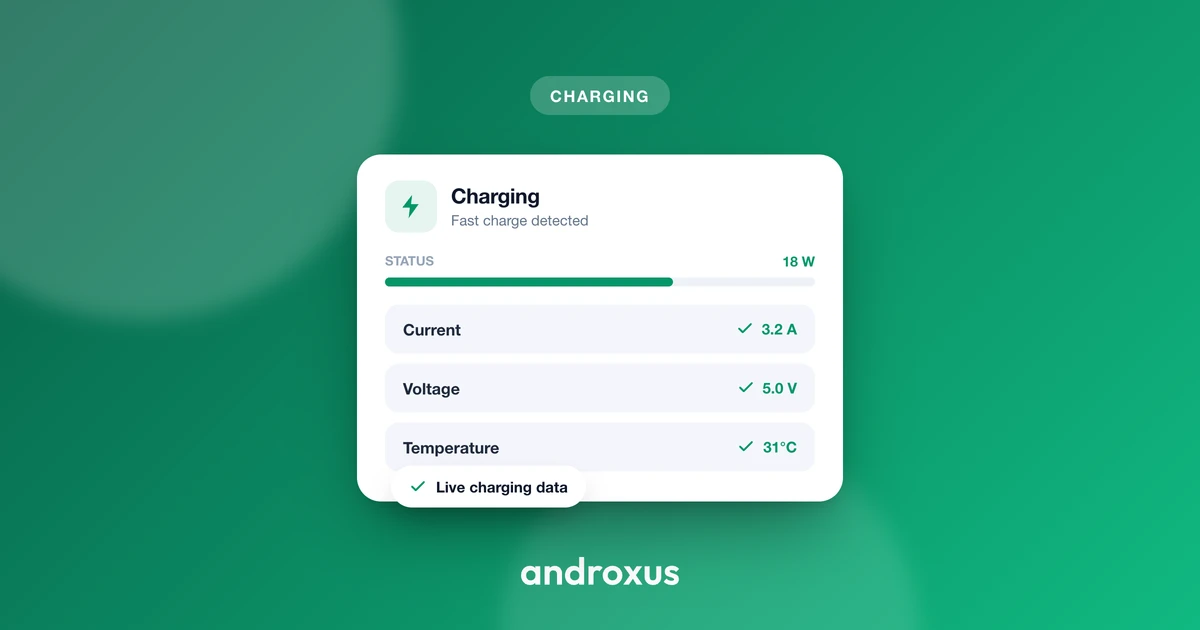
A phone that feels warm in your hand during a fast charge can be alarming, especially after years of headlines about battery fires. Most of the time that warmth is just physics doing what physics does, but there is a real line between normal and genuinely risky. Here is what battery temperature actually looks like across the charging range, and when it is worth paying attention.
Quick answer: Normal battery temperature while charging typically runs about 30-40°C (86-104°F), noticeably warm to the touch but never uncomfortable to hold. Phones are designed to operate safely up to roughly 35°C (95°F) ambient and will automatically slow or pause charging if the cell approaches about 45°C (113°F), which is the widely cited upper limit for safe lithium-ion charging. Anything hotter than that, or any physical swelling, smell, or hissing, means stop charging and let the phone cool down.
What you'll learn
- What counts as normal battery temperature at each stage of charging
- Why fast charging and wireless charging generate more heat than a basic cable
- The actual point where warmth becomes a real overheating concern
- How wattage, current, and battery capacity relate to the heat you feel
- Practical steps to keep charging temperature lower day to day
What Counts as Normal Battery Temperature
Warmth during charging is expected, not a defect. Lithium-ion cells perform best chemically in a 20-25°C (68-77°F) ideal range, and the broadly cited safe charging range for the cell itself is 0-45°C (32-113°F). During an active fast charge, it is completely normal for the battery to sit around 30-40°C (86-104°F), noticeably warmer than room temperature but nowhere near dangerous.
Apple states the iPhone's ideal ambient operating range is 62-72°F (16-22°C), with a functional range of 32-95°F (0-35°C) outside of which the phone may behave differently to protect itself. Android handles temperature similarly under the hood: the OS stores battery temperature internally as tenths of a degree Celsius through BatteryManager.EXTRA_TEMPERATURE, so a raw reading of 223 simply means 22.3°C.
Cold matters too, and it is often overlooked. Charging below 0°C (32°F) risks lithium plating on the anode, which permanently reduces capacity. So the real message is not "cooler is always better," it is "stay inside the range the chemistry was designed for."
Why Phones Heat Up During Fast Charging
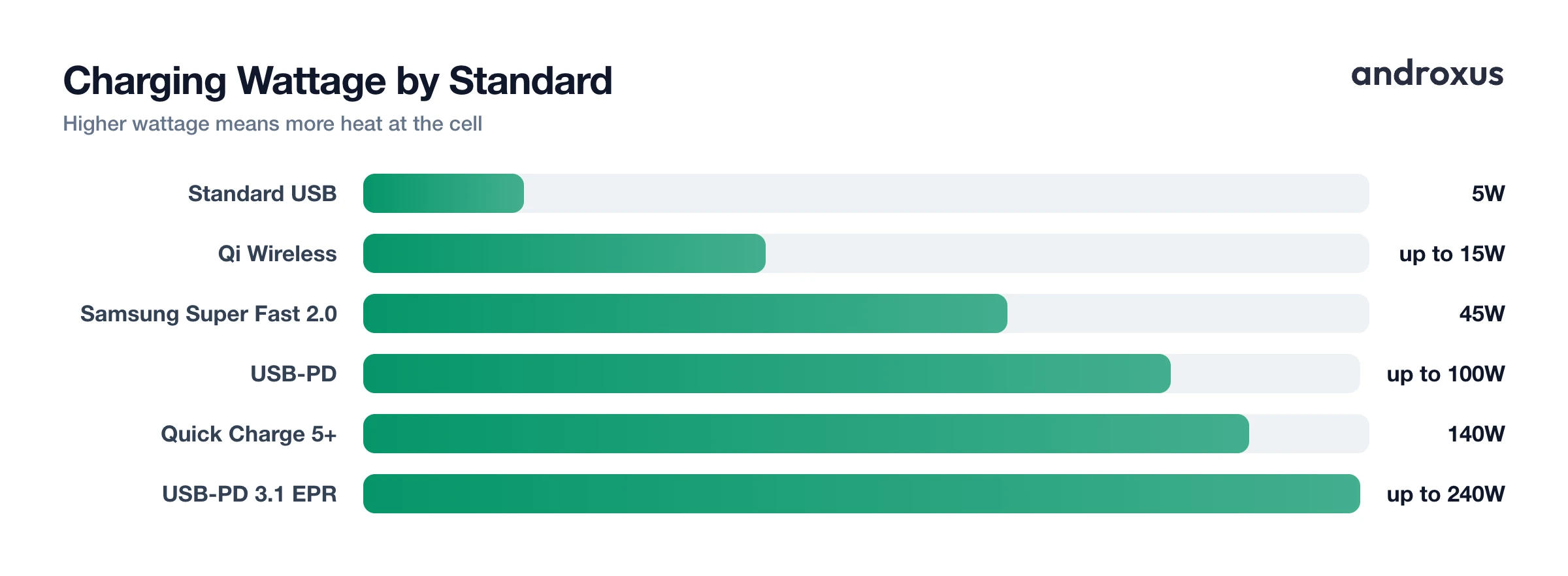
The heat you feel comes mostly from internal resistance inside the battery itself. Resistive heating scales roughly with the square of the current, so doubling the charge current roughly quadruples the heat generated at the cell. That is the core reason a 45W or 65W charger always runs warmer than a 5W or 10W one, even on the same phone.
The phone's power management chip adds its own share of heat while it regulates the incoming voltage and current, on top of whatever the cell itself produces. Modern fast-charging standards have pushed these numbers much higher than the old 5W USB baseline:
| Charging Standard | Typical / Max Wattage | Notes |
|---|---|---|
| Standard USB | 5W (5V/1A) | Baseline speed, minimal heat |
| USB Power Delivery (PD) | up to 100W | Standard fixed voltages, most phones and laptops |
| USB-PD 3.1 Extended Power Range (EPR) | up to 240W | Adds 28V/36V/48V rails, requires an EPR-rated cable |
| USB-PD PPS (Programmable Power Supply) | up to 100W (3.3-21V, up to 5A) | Fine 20mV/50mA control steps, used for closed-loop fast charging |
| Qualcomm Quick Charge 5 | 100W+ | First commercial 100W+ platform (2020) |
| Qualcomm Quick Charge 5+ | up to 140W (20V/7A) | Marketed for cooler thermal behavior at high wattage |
| Samsung Super Fast Charging 2.0 | up to 45W | Galaxy S and Note flagships |
| OPPO / OnePlus SuperVOOC | 80-240W commercial | 240W shipped on some Realme GT-series phones; 320W demoed in lab conditions |
| Qi wireless charging | typically 7.5-15W at the phone | Roughly 60-80% efficient, more heat than wired for the same power delivered |
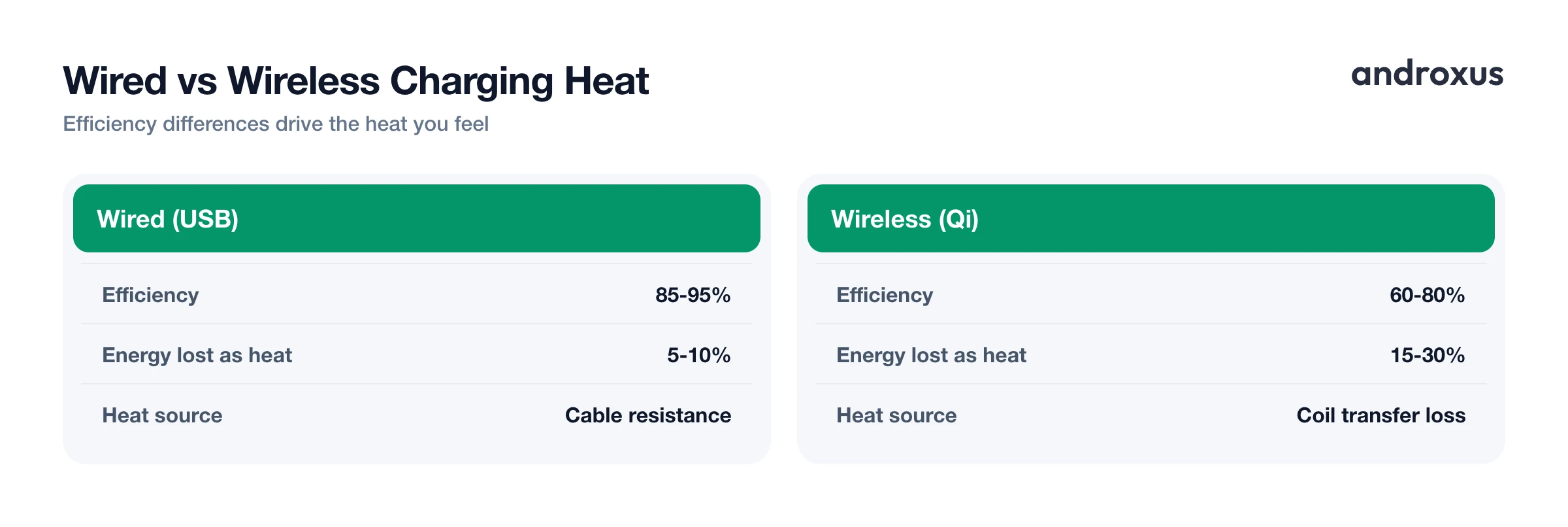
Wireless charging deserves a special mention because it is the one people notice the most. Qi charging runs at roughly 60-80 percent efficiency compared with 85-95 percent for wired USB, so a meaningful chunk of the transferred energy, 15 to 30 percent, is lost as heat right at the coil instead of going into the battery. That is why a phone on a wireless pad often feels warmer than the same phone on the same wattage over a cable.
When Overheating Becomes a Real Concern
Manufacturers generally design phones for a 0-35°C (32-95°F) ambient range, and the software backs that up. Apple's "Charging on Hold" feature pauses charging outright when internal sensors detect the device has gotten too hot, then resumes once it cools. Android phones from most major brands do the same thing under different names, throttling or pausing current rather than letting the cell keep heating.
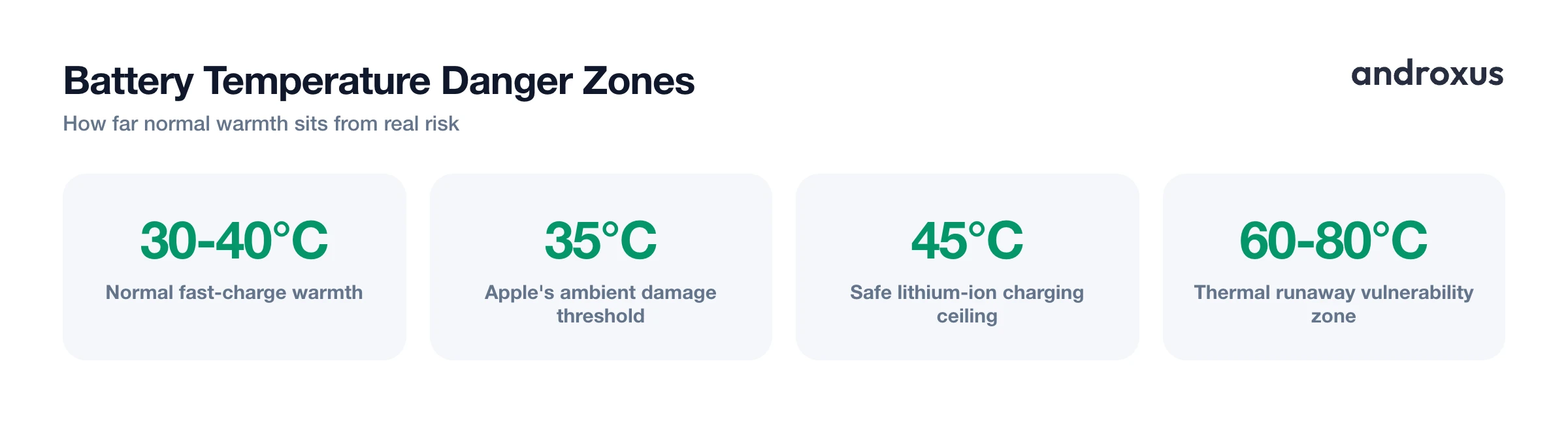
Apple explicitly warns against charging in ambient temperatures above 35°C (95°F), because sustained heat at that level can permanently reduce battery lifespan even without any dramatic failure. A cell temperature above roughly 45°C (113°F) sits outside the generally accepted safe lithium-ion charging spec, so a phone that consistently reads that hot during a charge is a real signal to unplug, not just cosmetic warmth to shrug off.
It helps to see how far away normal warmth actually is from true danger:
| Temperature Reference Point | Value |
|---|---|
| Apple's ideal ambient operating range | 62-72°F (16-22°C) |
| Functional ambient charging range (most phones) | 32-95°F (0-35°C) |
| Broad safe lithium-ion charging spec | 32-113°F (0-45°C) |
| Normal battery warmth during fast charging | ~86-104°F (30-40°C) |
| Apple's charge-damage ambient threshold | above 95°F (35°C), can permanently reduce battery lifespan |
| Thermal runaway vulnerability zone | above 140-176°F (60-80°C) |
| Critical internal decomposition point | ~266°F (130°C) |
| Active thermal runaway fire temperatures | 392-1,832°F (200-1,000°C) |
True thermal runaway is a much higher bar than everyday fast-charging warmth. Cells only become vulnerable above roughly 60-80°C, undergo critical internal decomposition around 130°C, and an actual runaway event can reach 200-1,000°C. Normal charging heat in the 30-45°C range is nowhere near that zone on a healthy battery. The signs of a real problem are physical, not just thermal: a swollen back panel, a burning or chemical smell, hissing or popping sounds, or a phone that becomes too hot to hold comfortably. Any of those means stop charging and have the battery inspected.
mAh, Watts, and the Math Behind the Warmth
The relationship between capacity and energy explains why bigger, faster-charging phones tend to run warmer. Watt-hours are calculated as Wh = (mAh x voltage) / 1000, so a 4,000mAh battery at a typical 3.85V nominal cell voltage stores about 15.4 Wh of energy. A 65W charger delivers roughly four times the wattage of a 15W charger pushing that same energy into the same battery, and since resistive heat scales with the square of current, that difference is very noticeable to the touch even though both chargers are working within spec.
This is also why comparing "how hot my phone gets" between two different chargers or two different phones is not a fair test unless the wattage and battery size are similar. A larger battery charging at high wattage will simply generate more total heat than a smaller one at the same wattage, without either one being unsafe.
How to Keep Battery Temperature Down While Charging
- Remove the case before fast charging. Cases trap heat against the back of the phone, especially during 45W-plus wired charging or any wireless charging session. Taking it off lets heat dissipate instead of building up around the battery.
- Charge in a cool, shaded spot. Keep the phone out of direct sunlight, off a hot car dashboard, and away from other warm electronics. Room temperature around 20-25°C (68-77°F) is the range lithium-ion batteries handle best.
- Use a properly rated cable and charger. A damaged, low-quality, or mismatched cable adds resistance to the circuit, and resistance is what converts electrical energy into heat. Stick with the phone's original charger or a certified USB-PD/PPS or Quick Charge replacement.
- Avoid heavy use while fast charging. Gaming, video recording, or navigation apps load the CPU with its own heat on top of charging heat. If the phone needs to charge quickly, let it sit idle rather than running demanding apps.
- Choose wired over wireless when heat is a concern. Wired charging is roughly 85-95 percent efficient versus 60-80 percent for wireless, so it generates noticeably less waste heat for the same amount of energy delivered.
- Watch live watts, amps, and temperature. A meter app like AmpereFlow shows the actual charging power and battery temperature in real time, which makes it easy to notice if a particular cable, charger, or case is consistently running hotter than normal for that device.
Key takeaways
- Warmth in the 30-40°C (86-104°F) range during fast charging is normal; discomfort to the touch or readings near 45°C (113°F) is not.
- Heat scales with the square of current, so higher-wattage charging and wireless charging will always run warmer than a basic wired charge.
- Sustained heat above about 35°C (95°F) ambient is the real long-term threat to battery lifespan, not brief warmth during a single fast charge.
- True thermal runaway only starts around 60-80°C, far above anything a healthy battery reaches during normal charging.
- Removing the case, charging in a cool spot, and using a properly rated cable are the highest-impact, lowest-effort ways to keep temperatures down.
Frequently asked questions
What temperature is too hot for a phone battery while charging?
Sustained readings above roughly 45°C (113°F) at the cell are outside the safe charging range widely cited for lithium-ion batteries. Most phones automatically slow or pause charging before reaching that point. Brief warmth up to about 40°C (104°F) during fast charging is normal and expected.
Is it normal for a phone to get warm during fast charging?
Yes. Pushing more current through the battery's internal resistance generates heat that scales roughly with the square of the current, so a 45W or 65W charger will always feel warmer than a 5W or 10W one. Warm to the touch is normal; too hot to hold comfortably is not.
Why does wireless charging make my phone hotter than a cable?
Wireless (Qi) charging is roughly 60 to 80 percent efficient compared with 85 to 95 percent for wired USB charging, so 15 to 30 percent of the transferred energy is lost as heat at the coil, versus about 5 to 10 percent for a wired connection.
Can charging temperature actually damage my battery long term?
Yes. Heat is the single biggest driver of long-term lithium-ion capacity loss. Apple specifically warns against charging in ambient temperatures above 35°C (95°F) because it can permanently reduce battery lifespan, and general lithium-ion guidance puts the safe charging ceiling at about 45°C (113°F).
How can I check my phone's actual battery temperature?
Android stores it internally in tenths of a degree Celsius. Samsung phones expose a readout under Settings, then Battery and device care, then Battery. On most other Android phones you need a monitoring app such as AmpereFlow, which reads live temperature and voltage alongside charging watts and amps.
What should I do if my phone feels dangerously hot while charging?
Unplug it, remove the case, and move it away from direct sun or heat until it cools down before charging again. If you notice swelling, a burning smell, hissing, or the phone becoming too hot to hold, stop charging entirely and have the battery inspected rather than continuing to use it.
